会议ISBI 2026发表论文:DDRT :利用强化学习解码任务功能磁共振成像中层级脑中心的动态交互
论文“DDRT: Decoding the Dynamic Interaction of Hierarchical Brain Hubs Using Reinforcement Learning in Task fMRI”被会议“IEEE International Symposium on Biomedical Imaging 2026”接收
时间:2026-01-13
关键词:脑影像人工智能,文章接收
近日,硕士研究生刘璇在医学图像处理领域会议“IEEE International Symposium on Biomedical Imaging 2026”发表题为“DDRT: Decoding the Dynamic Interaction of Hierarchical Brain Hubs Using Reinforcement Learning in Task fMRI”的文章,通讯作者为张枢教授。
Identifying pivotal hubs within brain networks and elucidating their role in the dynamic expression of functional networks is fundamental to understanding brain functions. Conventional methods are largely constrained by time-invariant models that overlook dynamic network reconfiguration, while prevailing dynamic functional connectivity paradigms often miss the hierarchical organization crucial for efficient information processing. To address these limitations, we propose a universal brain analysis framework called DDRT to precisely identify key brain regions decisive for functional integration within specific, task-relevant time windows. The reinforcement learning agent identifies the most critical nodes by utilizing a hybrid reward function that balances a node’s marginal dynamic influence with its static topological importance. Our results reveal that the brain’s functional organization adheres to a three-tiered dynamic hub architecture: Core Hubs, Flexible Hubs, and Peripheral Hubs. Topologically, these hubs demonstrate remarkable structure-function consistency, with the average fiber tract length and gyrus-to-sulcus ratio decreasing hierarchically across the three layers—such as the Core Hubs featuring the longest average fiber tracts (90.52) and a high gyrus-to-sulcus ratio of 11:4. This framework frames dynamic hub identification through the integration of dynamic influence and static topology, representing a powerful new paradigm for exploring the brain’s hierarchical features and dynamic working mechanisms.
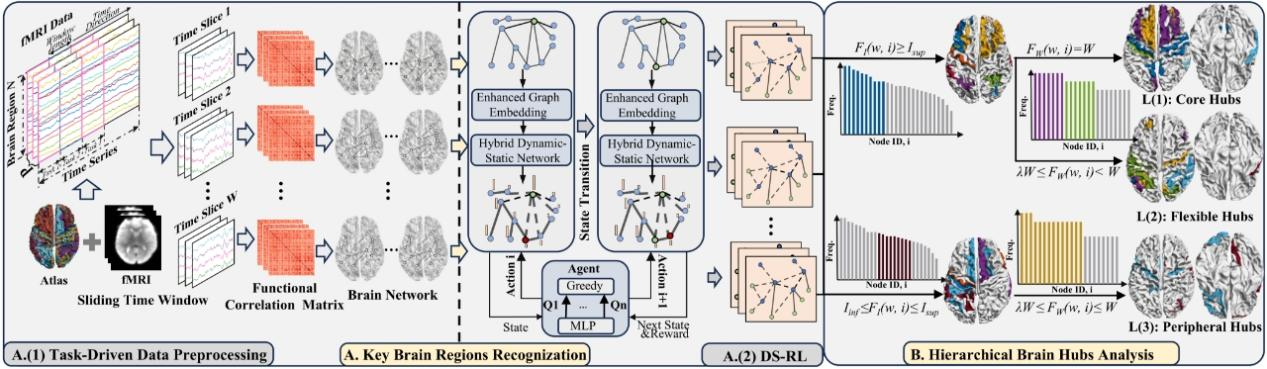 图1:论文框架。