会议MICCAI 2026发表论文:BrainTM: :基于层级时空 Transformer-Mamba 模型从功能网络解码大脑状态
论文“Brain-TM: Decoding Brain States from Functional Networks Using a Hierarchical Spatiotemporal Transformer-Mamba”被会议“Medical Image Computing and Computer-Assisted Intervention 2026”接收
时间:2026-06-24
关键词:脑影像人工智能,文章接收
近日,硕士研究生刘璇在医学图像处理领域会议“Medical Image Computing and Computer-Assisted Intervention 2026”发表题为“Brain-TM: Decoding Brain States from Functional Networks Using a Hierarchical Spatiotemporal Transformer-MambaI”的文章,通讯作者为张枢教授。
Understanding the dynamic transitions of brain states is crucial for comprehending the working mechanisms of the brain. However, accurately decoding these states from functional networks remains challenging, as existing methods lack the interpretability to reveal how internal hubs drive brain integration. To address this issue, we propose Brain-TM, a hierarchical Transformer-Mamba framework designed to decode brain states from functional networks. Evaluated on the HCP dataset across 7 cognitive tasks, Brain-TM achieves a superior classification accuracy of 94.7%. Beyond its predictive performance, it offers a biologically interpretable framework by proceeding at three analytical levels. Firstly, we identify task-specific network representations, demonstrating that latent brain states correspond to distinct cognitive demands across varying temporal windows. Secondly, we reveal a hub-based mechanism across brain states, showing that global network integration is fundamentally orchestrated by localized hub activations. Finally, we investigate the topological characteristics of functional hubs, validating their dominance via centrality metrics and benchmark comparisons. In summary, Brain-TM successfully decodes spatiotemporal dynamics, revealing that internal hubs play a pivotal role in driving brain states.
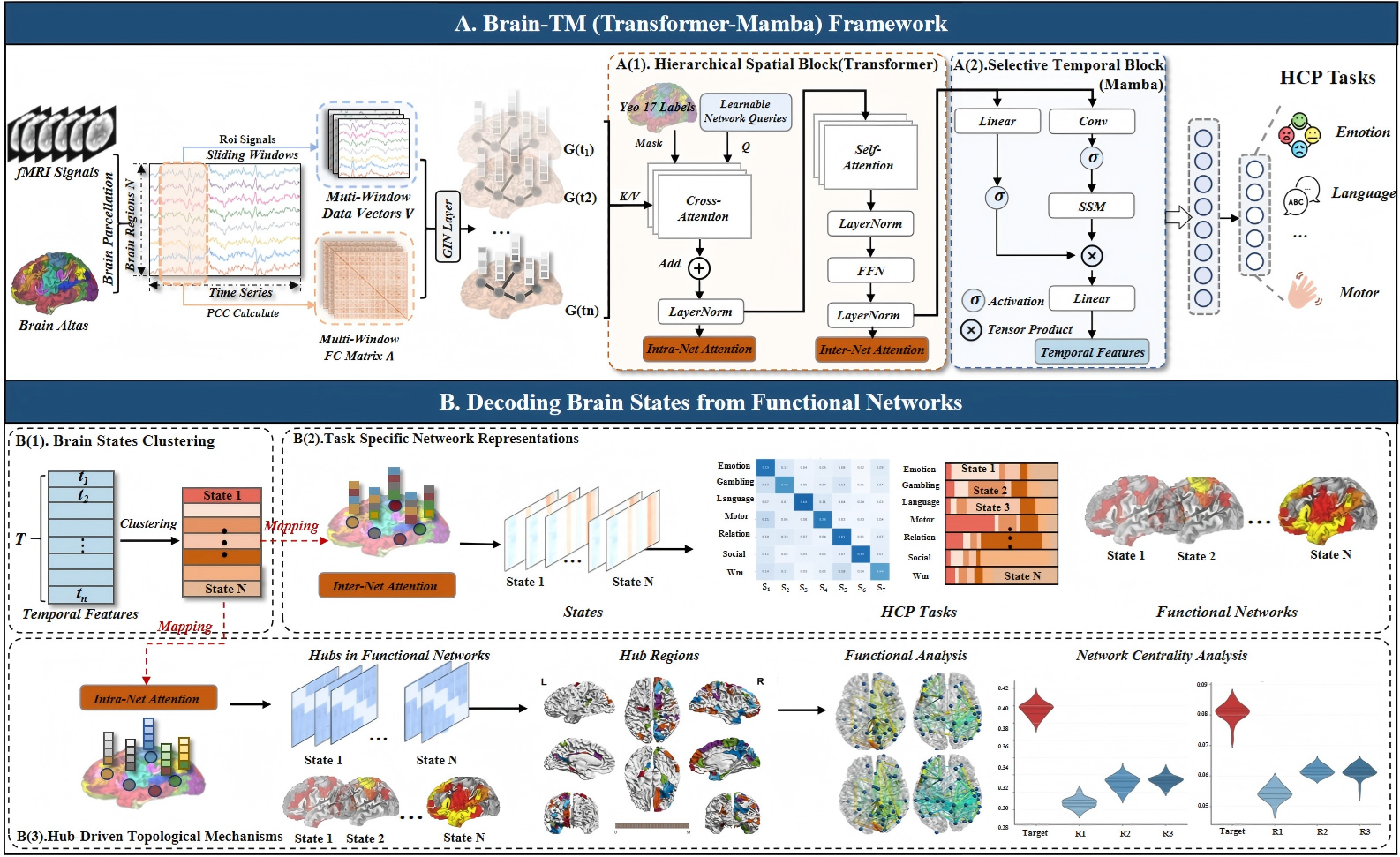 图1:论文框架。