期刊 JBHI 发表论文:基于层次化注意力机制和时序卷积网络的多尺度脑电信号解码方法
论文“MuST:Multi-Scale Transformer Incorporating Hierarchical Attention and TCN for EEG Decoding”被SCI一区期刊IEEE Journal of Biomedical and Health Informatics接收
时间:2026-02-28
关键词:脑机接口与智能机器人,文章接收
近日,硕士研究生赵奎在 IEEE JBHI(sci一区)发表题为“MuST: Multi-Scale Transformer Incorporating Hierarchical Attention and TCN for EEG Decoding”的文章,通讯作者为张枢教授。
Electroencephalography (EEG) signals exhibit significant and inherent time scales differences across individuals and tasks. Despite notable successes in decoding EEG signals in single-tasks (e.g., detection of epilepsy), where the time scales are relatively consistent, substantial differences in temporal characteristics among various tasks pose a significant challenge. To address these limitations, we propose the MuST, which stands for Multi-Scale Transformer, aiming to dynamically learn characteristics of EEG signals on different time scales. Building on the conventional Convolutional Neural Network (CNN)-Transformer model, the MuST introduces two innovations: (1) A hierarchical Transformer structure to dynamically capture global dependencies and long-range information from EEG signals at different scales. (2) A novel temporal convolutional network (TCN) module to replace the original feed forward network (FFN) module in the Transformer, effectively capturing local temporal patterns and short-term dependencies from EEG signals. To validate the performance of the MuST, we conducted experiments on five public EEG datasets with extreme time-scale differences. The experimental results on these datasets demonstrate that we have achieved an average classification accuracy of 91.69% under identical parameter settings. This surpasses the baseline EEGNet by 5.65%, highlighting its superior capability in handling multi-scale EEG signals for diverse tasks. More critically, MuST demonstrates a successful unified modeling of EEG temporal heterogeneity through mixed dataset training (epilepsy detection and sleep staging classification). This breakthrough validates our multi-scale architecture’s capability to dynamically reconcile divergent neurophysiological timescales within a single model.
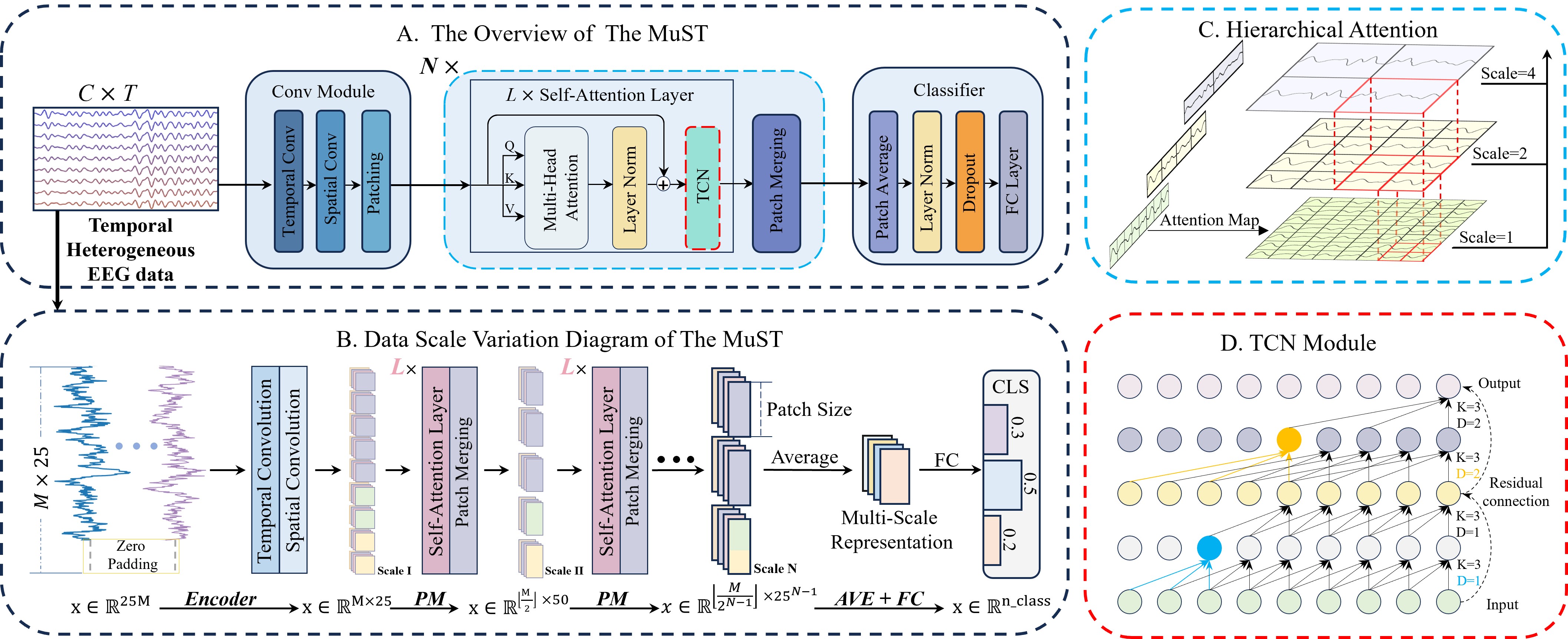 图1:框架图。